Click below to read a story of success and optimism from a late ’80’s class in Tipton, Indiana. The experience helped shape success in the students, players, band members, cheerleaders, and the community.
Things People Might Say or Do to Motivate and Stay on Task
Have you ever been somewhere, where you wanted to be when you first got there, and then you wanted to leave?
And you wanted to leave a little before it seemed socially appropriate?
I usually want to be where I am, and my brother usually wants to be where he is going next.
I have noticed that once I get somewhere, I tend to need to prepare for a time that I’ll move on to something else if I don’t have something specific scheduled. I’m not a big crowd person, so as things thin out sometimes that’s my favorite part of a social activity.
I think an accurate description for my brother and me is that I have a little less inertia at times (or a little bit lower than some), so I like to stay where I am. He has a little more forward inertia, because he tends to want to be moving to the next thing just a little before what he’s doing ends.
He tends to set a timeline which allows him to stay long enough, and then he frequently leaves just a little bit before that time is up. He’s ready for his next activity, and starting to prep for that as he gets close.
As you may guess, he tends to be a little early to things, and my natural inclination is to be right on time, with a little room for error.
An example of me preparing for my next step is that I start to think of myself in the next time zone if I’m flying somewhere or driving somewhere different than where I live, and a little before I arrive there.
Then when I get there, my pretty consistent meal schedule is a little closer to what will occcur.
I was sitting in my local Starbucks last week, where I have gotten to know several other people who also spend time in Starbucks.
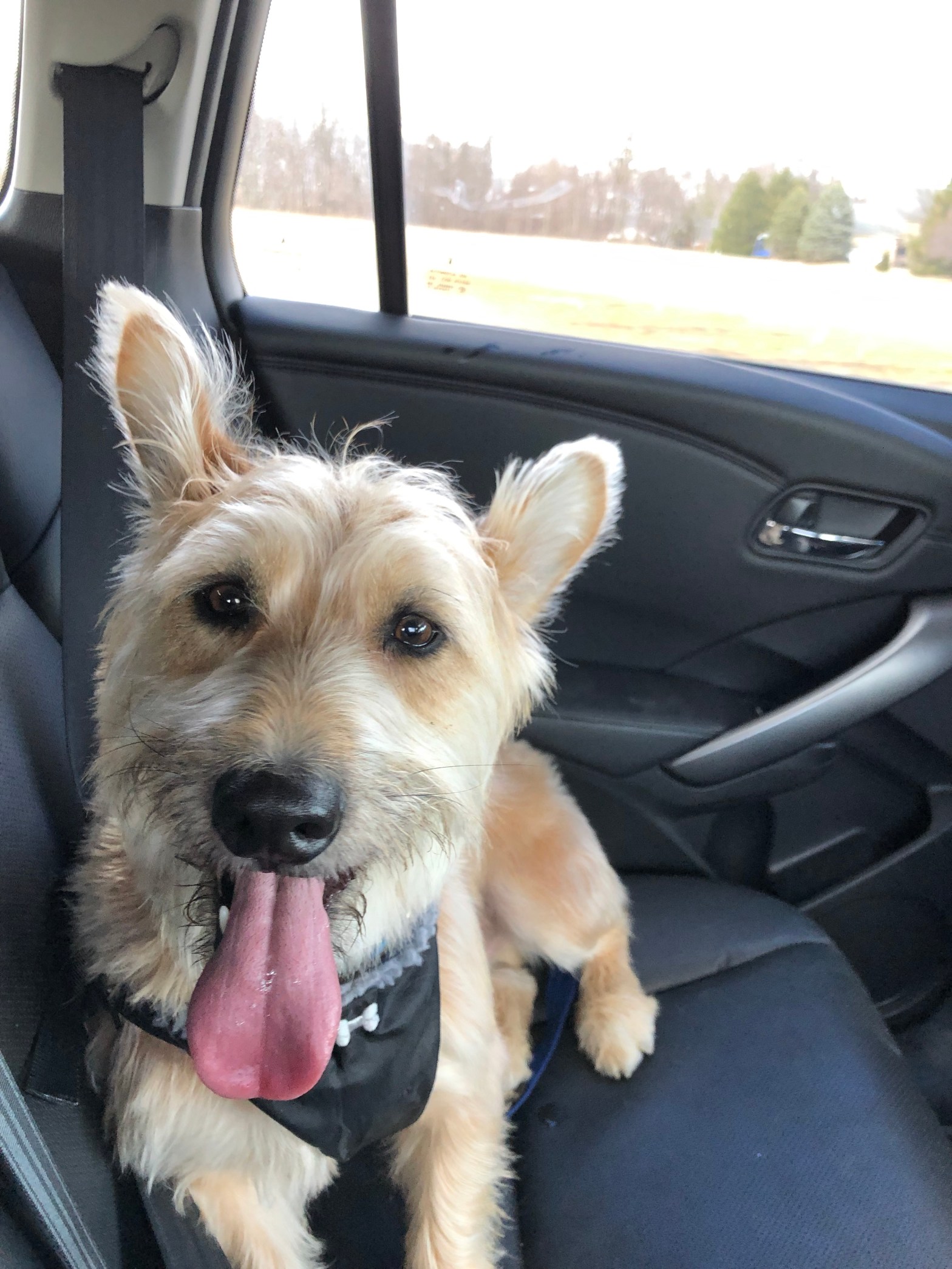
Currently, I have custody of the grand-pup.
My son, one of the puppy’s dads, was home sleeping, and so was Mosby, our puppy. He is just about 1.5, so he’s still got another 1.5 years of puppy-dom.
The person I was sitting next to had to leave to drive to a different town. I utilized that opportunity to leave as well, since I wanted to make sure I got home to the puppy at a decent time related to when he woke up. He was on college time, which has a later start than my natural tendency to start my day.
I said ‘I need to let the puppy out’. This was a true statement, and was what was helping motivate me to move from my current location of Starbucks.
My new friend was reminded of someone who used to say that as his goodbye-line. The person, according to the man telling the story, used to say that everytime he was ready to leave.
It is probably the equivalent of saying ‘I have to go, I have a meeting’, which I said a lot in my previous role as one of the directors at a local social service agency.
The thing was, I almost always did have a meeting to attend. I supervised 13 staff, had meetings in four counties, and I have a tendency to chat.
To help curtail my tendency to chat a little too long, in that role of work I would try to limit my chatting times to right before I needed to leave to be somewhere.
That gave me a little time pressure, and my bag of stuff to come with me, or coat, were indicators to the staff who may have been using that opportunity for questions or getting some feedback on their role…or just an anecdote.
Kind of like building in room for traffic, or an emergency, or allowing for error.
So, this leads me to a couple of things to think about for today:
What things do you like to say when you need to transition from one location to another, and you don’t have a ‘work’ or ‘obligation’ reason to do that?
What helps motivate you to go somewhere, when you would rather stay where you are?
If you are someone who has trouble motivating yourself to start doing something; what self-talk, action, or reward do you give yourself to help yourself get it done?
If you are someone who is more likely to stay where you are:
What words, phrases, or incentives do you use to help yourself get to that next place?
If you always want to move onto the next thing, what timelines do you give yourself to stay where you are before moving on?
Now for today’s goal:
Here’s an idea:
Set yourself a goal to do something, whether it is a work obligation, a fun obligation, or just something for you, and try to make that happen.
Now set a goal for when you want that to happen:
…how about today, tomorrow, or at least this week?
Maybe longer?
Here’s my motivation: An Afternoon at the Beach with my kindle
Have a great day!
Hope your motivational efforts are effective and help you complete a task or two today.
A good friend was talking with me this morning about this frustration. I have also noticed that kids who are around 20ish are not nearly in the rush to grow up that I was.
Her specific frustration was about an adult in her life who is not as big of a fan of sharing the tasks related to maintaining their home as she would like.
She had been talking with her dad, who had noticed the same frustration occuring among females he knows who are associated with men in their lives.
As a parent of 2 boys and a wife to a husband, I recognize things I have done througout the years to encourage them both to complete tasks, and to be needy in other areas.
I like things done a specific way.
For instance, when we are all folding laundry together (something we do less often since they live in Bloomington, Indiana and I live in Noblesville, IN), I like things stacked by the drawer they belong in once they are put away.
So, pants go in a pile, socks go together by user, and t-shirts go in a pile by owner.
Seems pretty easy, right??
I can tell you that it has not been an easy training for 2 of my 3 trainees. One of my sons has a brain that organizes similarly to mine, so he automatically does it what we call ‘the right way’.
My other son, who is a little craftier in how he completes his tasks, learned to fold v e r y slowly. He would give me a hug when he was younger than 13 or so, which of course I appreciated.
Interestingly, he folded fewer items than the rest of us.
I watch the 20 somethings who work when I attend local restaurants, coffee shops, and clothing establishments.
One of the things I notice is that the teens and twenty somethings are very good at completing specific tasks.
Frequently, if you give them a task, they put their head down, focus internally, and complete it.
Almost as if they had their face in a phone.
They can be very friendly while asking for your order, but being friendly WHILE they enter your order into the cash register seems more difficult.
Another thing I have noticed is that in the community where I live, there are older, pseudo-retired people who are helping the youth learn to take orders from people in eating/coffee establishments.
I get called ma’am, sweetie, honey, etc. more now than when I was younger, more spoiled, and cuter.
A couple of questions to leave you with today:
What helps you complete tasks without being told to do them? What is your intrinsic (internal) enjoyment at completing things that are necessary, and how do you go about getting those tasks completed?
What do you think is something, one thing, that you can do to help others around you complete the tasks about which you tend to micro-manage?
If the other person is a child, I encourage you to help them come up with a way to complete a small task, which you can then give them some positive reinforcement for completing.
This could be clearing their plate from the table, getting dressed without being asked, avoiding whining when asked to brush their teeth, etc.
It will be something that you want them to complete without your assistance.
If the person you are wishing would complete more tasks is a life partner, spouse, or loved one, I encourage you to talk together, at a time when neither one of you is angry, about a couple of tasks you each wish the other one would do more often.
Have a conversation, where each of you is allowed to speak and be heard, about an idea you have and then listen to the feedback about how your loved one, friend, or roommate feels about that task.
Come up with one for each of you, or one for yourself, and try to make it happen.
Hope you enjoy a youthful moment today. Enjoy your Monday!
I love sitting in the near quiet, this morning with a very tired dog at my side and a sleepy husband upstairs.
I love the chance to do what I want with zero time limits.
Let’s talk about time
I grew up in a house where time (the time on a clock) was very important.
With parents who were teachers (music teachers, no less), they had to pay very close attention to the clock all of the time to make sure their students came and went at the appropriate time to get that ‘specials’ time in.
With a brother as a teacher who also coached swimming for several years, we often joke that he pays attention to time to the milisecond, and I round to 15 minute intervals.
In the social service world, most time increments are rounded to the closest 15 minutes.
We know that if it is 7 minutes or less past the hour, it counts at 4:00, but get it to last until 4:08 and you are talking 4:15.
One of my favorite parts of Saturdays in the house where my children grew up in is that we did not pay attention to the clock nearly as much on weekends as we did during the rest of the week.
We ate when we got hungry.
That can be challenging when we are trying to eat together and we have all woken up at different times.
There are several questions about what time each of us has eaten breakfast, and if you do not eat breakfast at all then you want your lunch the earliest of all of us.
During my sons’ teen years, waking them up in time for lunch was a pretty significant challenge, so we frequently either ate without them or convinced them to go pick us up something to eat from one of our favorite restaurants (shout out to Chick Fila and QDoba here)
Now that we are primarily empty nesters, time is even less important. My natural rhythms get me up with the sun, or a little before. I spent my middle school years having practice before school, so I literally wake up ready to play basketball or volleyball (be glad you don’t live with me-I’ll launch right into that conversation we left off with last night as if we are still mid-thought)
For my differently circadium rhythm’ed husband, mornings are not nearly as exciting as they are to me. He loves to sleep until he wakes up, which is not necessarily when the sun is coming up, although with the noises in the house (ahem, guilty) it is usually near that time.
Ahhhh….Quiet Time
This morning, I’m having a quiet morning with our Grand-Puppy, Mosby. He is nearly 1.5 years old; he usually lives with college students so he too likes to sleep in, and he was so grateful when I let him out real quick to go to the bathroom when I came downstairs at 6:45 (after 45 minutes of being awake).
How This Can Apply to You
Here are a couple of questions for today:
What are some simple pleasures you really enjoy? When you think of something that really makes you think ‘wow, that is just something I really enjoy’, what images or sounds comes to mind?
A sound I love is acoustic music. When I imagine Eric Clapton playing on ‘Unplugged’, I can feel myself getting more relaxed.
What is a sound that is helpful?
I love to look at water.
How are you able to get those needs met as you also parent, work, relax, talk with friends, and avoid talking with people you would rather not talk to?
What are some ways you can work to increase the amount of time you focus on your simple pleasures? How can you spend a day ignoring the clock and listening to your belly to know it is time to eat, or a day where you are driven by the clock to do things you want to do?
Ever get angry when you overhear somebody saying something that really bugs you?
Something I personally have a quick anger response to is when someone points out I am wrong when I thought I was correct.
I struggle with admitting I am incorrect when I am JUST SURE I was correct about something. Conversely, if I already thought I was wrong, I’m pretty OK with it.
For example, when involved in a game of trivia, I love to throw out a potential answer that sounds confident. If I’m wrong about that, well, you shouldn’t have picked my answer. Being wrong when I am not confident in my accuracy does not bother me nearly as much.
An example of being potentially incorrect occurred when I was in high school.
I remember playing a game of Trivial Pursuit in our Psychology class. The class was one of my favorites (I went on to major in it in college), the teacher was young and fun, and we were in groups.
The question went something like this: ‘What is the only city to own their NFL football team?’
I yelled out ‘Green Bay Packers!’. My team went with my answer, as I sounded confident and as if I knew what I was talking about.
In this example, I was correct. To this day, I have no idea what made me say the Green Bay Packers answer. I do like the colors of the team, and I just threw it out there.
The Green Bay Packers, in the late 80’s, were the only NFL team owned by the city, which was Green Bay, Wisconsin.
I was gleeful.
The game we were playing, while being both entertaining and engaging for high school students, also represented a couple of psychological phenomenons.
One of those is a term called ‘Group Think’. In Group Think, if enough people agree about something, they will convince themselves they are correct due to several of them being in agreement. Think ‘we must be right, because we all think the answer is yes’.
A group of people, while brainstorming about something, or trying to decide which Trivia answer which has been thrown out is correct, start to become convinced of the accuracy of an answer once enough people in the group believe it to be true.
Another interesting psychological effect of groups is known as the ‘Abilene Effect’. This one is particularly interesting to me, and frequently happens when people are trying to decide on a place to go together.
In the Abilene study, one person wants to eat dinner at one place in Texas. I am not sure where it is, but let’s call it Frisco.
Another person in the example wants to eat somewhere else in Texas, let’s call it Waco. There is no one single place that everyone wants to go, but Abilene seems the least offensive to the group in this example.
The group of people ends up eating dinner in Abilene, Texas which is a two hour drive from where they started.
The reason they agreed upon Abilene is because no one wanted to be the person to insist upon eating at the place that they had been the only person to choose. Rather, they would prefer to go to the place that most people could agree was not as terrible of a choice for the group.
In this example, no one in the car wants to drive to Abilene at all, they just didn’t really know where it was, or didn’t hate being there, or something like that. (this study was also popular in the late ’80’s in my Organizational Psychology class, Z300 for Indiana University Kelley School of Business students at that time)
For today’s topic, which is Trigger Words that make us feel strongly when we hear them, I urge you to think about a couple of trigger words or phrases that cause strong feelings within you.
It could be a positive phrase. One phrase I frequently use with my own children is ‘Be Wise’.
I feel better saying it, and it encompasses a whole lot of things for them to be wise about as they continue into their 20’s.
I like to say it, and they tolerate me when I say it. I have another friend who yells out ‘Make Good Choices’ when their college age child is walking away.
It could also be a phrase that really upsets you, or ‘gets your goat’. For my family of origin, we loved to quote the character Fonzi from the show ‘Happy Days’.
Fonzi struggled to admit he was wrong, so when he said he was wrong it sounded like ‘I was wro……I was ronnnn…..I was waaa waaa waa…..’
In our family, the person who was wrong starts that little sequences of sounds/words.
Following this, the other member of my family of origin happily supplies ‘Wrong?? You were wrong?’
The smile that follows that interaction is as predictable as the interaction itself.
I leave you with a couple of questions:
What is something you would like to hear from someone else or think to yourself?
If it is something you say to yourself, or ‘self talk’, what nice thing can you tell yourself today, and what phrase that you enjoy hearing from someone else helps uplift your spirits, or triggers positive feelings?
What is something you wish didn’t cause you so many feelings, either said by you, a close friend or family member, or even someone sitting at a nearby table. How does this word, phrase, or sound trigger negative feelings in you?
The Sun as it Rises Over the Ocean
Enjoy your day and I hope you hear some sounds you love today!


 Playing some Pick Up Basketball



 Parke Therapy and Artistry